Keep kids safe: 6 essential safety skills every parent should teach their child
Share

Hey, $mart parents 💡
Bring money lessons home with Greenlight’s $mart Parent newsletter, a quick read with impactful tips — delivered free to your inbox weekly.
Key Takeaways
The best time to teach your kid what to do in an emergency is long before one happens. Children who’ve practiced safety skills, even through games and roleplay, are far better equipped to act calmly when fear kicks in.
Teaching kids how to call 911, spot a safe adult, and stay secure online empowers them to face scary situations with confidence instead of fear.
Here are six essential safety rules to start teaching today.
1. How and when to call 911
Knowing when to dial 911 or other local emergency numbers is a key part of an emergency contact plan, especially for kids. Learning what counts as an emergency is an important part of using 911 for children as young as 3.
Use the following questions to help kids decide when to use 911:
Does a grown-up need help? Is a grown-up not waking up?
Is your friend hurt and there’s no adult around?
Is someone breaking into your house?
Is something happening to the house, like a fire or flood?
Has there been a car accident?
Is someone following you while you’re walking home from school?
How to teach kids to call 911
Kids may not always know how to recognize the extent of an injury or vehicle accident, but by giving them parameters for recognizing when an adult may need help, you can teach them the appropriate times to call for help. Also, talk about when not to call 911.
Role-playing practice
Practice doing the following:
Opening a locked cell phone
Dialing 911 (without pushing the buttons!)
Providing information like name, location, and different emergencies
2. Basic fire safety rules like “stop, drop, and roll”
A key to responding safely in fire emergencies is to practice. Fear, smoke, and darkness during a fire can be disorienting. If your child has built their muscle memory for stop, drop, and roll and finding a safe route outside, their chances of being safe improve.
How to teach kids fire safety
Real emergencies are terrifying, but fear won’t help kids prepare. Engaging drills and repetition can help reinforce important safety factors.
Role-playing practice
What happens if your clothes catch fire? Take the freeze dance approach to teach what to do. Play music and dance. When the music stops, everyone stops, drops, and rolls.
What happens if there’s a fire in the house? Pretend to be on an adventure while practicing leaving the house, crawling close to the ground, and meeting at your chosen fire safety rendezvous point.
3. Traffic safety habits
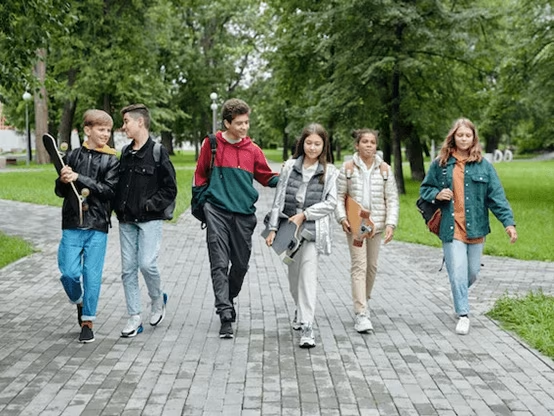
More than 15,000 children are injured each year from being hit by a vehicle while walking. What’s more, teenagers are now the most at-risk youth for pedestrian injuries.
Dangers like moving vehicles and crossing traffic are everyday situations many kids face and should be prepared for. Learning traffic safety habits will help them as pedestrians and as drivers down the road.
How to teach kids traffic safety
Eyes up, phones down. Parents worry about the dangers of inattentive drivers due to mobile devices, but the same holds true for inattentive walkers.
When they are walking, they should look left, look right, then look left again before they cross.
Make sure a car is stopped before they cross and that the driver can see them. Make eye contact with the driver.
Role-playing practice
Have your child be the leader for your neighborhood walk, and let them navigate (with your close supervision). Practice crossing streets, pressing the “walk” button, identifying walk lights, and navigating parking lots and neighborhoods with awareness.
4. How to identify safe adults and handle “tricky people” situations
Not every stranger looks dangerous, and “stranger danger” alone doesn’t give kids enough to go on. Teaching kids how to identify trustworthy adults and recognize uncomfortable situations gives them a practical framework for staying safe.
What to look for
You can discuss stranger danger, but an even more important lesson is how to spot “tricky people.” The way grown-ups behave is an even better clue about who is safe.
Safe adults are ones already vetted by a larger organization, like a teacher or a police officer. Often, they can be identified by a uniform or ID tag.
Tricky people can be strangers or someone you know who uses manipulation, secrets, or boundary violations to get your children to do something unsafe.
Parents who are out with their own kids can be a safe option too, especially if there is no professional in a uniform around.
Remind kids that adults don’t ever need a kid’s help. Not for finding a lost puppy. Not for approaching their car to give directions.
Role-playing practice
Pretend to be a tricky person offering candy or asking for help finding a lost pet.
Teach your child to take a step back, say “No,” and run to a trusted adult.
Switch roles so your child practices asking for help from an adult in uniform.
5. What to do if they get lost in public
Getting lost at a mall or the grocery store is a common occurrence for kids. You may even remember a time when it happened to you as a child. GPS trackers like Greenlight's GPS device can help make losing your child a lot less likely, but they should still be aware of what to do if they get separated from you.
How to teach kids what to do if they get lost
Many locations have protocol for lost children, but you can teach your child what to do as well.
Most of the time, staying in place is the safest option. This is true in stores, but it also holds true for outdoor activities where rescuers may be looking for them on a hiking trail.
The moment they realize they are lost, they should call your name loudly.
Role-playing practice
Pretend you are in a crowded place. Announce “The forest is getting windy! Find a tree to hug!” Your child must find a stationary object (a pole, a tree, a sturdy pillar), hug it tightly, and wait for you to find them.
Practice having your child call for you from different rooms, and you have to find them.
6. Internet safety basics and how to ask for help online
Safety isn’t just for the physical world. If your child is getting their first cell phone or you’re wondering whether it’s safe for them to play Roblox on their own, it’s a good idea to set some clear internet rules and safety tips.
How to teach internet safety
Focus on identifying safe interactions and on how to use the internet to get help in unsafe situations, such as reporting someone who makes them feel uncomfortable online.
Make it clear that it’s hard to know who they are really talking to online, and that some adults pretend to be kids.
Sharing personal information, such as a phone number or address, or sending photos of yourself to anyone you meet online, is a no-go.
Meeting people from the internet in person should never happen.
Role-playing practice
Show your child how to use the in-game block and report buttons if someone is using mean language or acting inappropriately. Practice different scenarios of when this should be used, such as if someone asks for a photo of your child or uses bigger words than kids typically use.
Help your child stay safe with the right tools
It might be your number one mission to keep your kids safe, but there are times when they’ll be away from you. Help them stay safe with the smart tools right from the get-go.
Check out the all-in-one Greenlight family safety solutions right in the app, where you can already manage their chores and allowance. Built-in GPS family location sharing with customizable alerts, SOS features, and vehicle crash detection†† keep you in the know as kids gain independence.
††Requires mobile data or a WiFi connection, and access to sensory and motion data from cell phone to utilize safety features including family location sharing and driving alerts and reports. Messaging and data rates and other terms may apply.
The Greenlight Safe Family device, for Kids, Seniors, or Pets, requires the purchase of the device and a monthly data plan for connectivity. Existing Greenlight customers must be on Core, Max, Infinity or Family Shield plans to use the device. Device is not available for use with Select or Greenlight+Invest plans. See Terms for more details.
Share