Hey, $mart parents 💡
Bring money lessons home with Greenlight’s $mart Parent newsletter, a quick read with impactful tips — delivered free to your inbox weekly.
Key takeaways
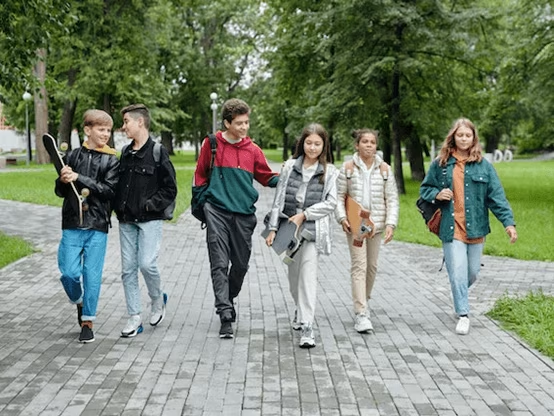
No states set a legal age for walking home from school alone. Most guidance points to around age 10 because that’s about when children can judge how fast a car is moving and how much time they have to cross. Younger kids tend to assume that a car they can see is a car that can see them.
Even when you understand the law and the expert advice, it’s a big decision to allow your child to walk alone, but it’s your call. The more challenging question is whether your child is ready and whether they have the right safety skills to handle the route safely.
Is there a legal age to walk home alone?
No state has a law that gives an age for walking home from school alone, and there’s no federal law. A provision in the Every Student Succeeds Act states nothing in it stops a child from walking to and from school with parental permission.
This means the legal age to walk home from school alone in the US is up to parents and any local regulations. However, other kinds of rules can still apply.
Supervision laws: Only three states have statutes naming a minimum age for leaving a child unsupervised. Another dozen or so states publish recommended ages through their child welfare agencies, but the recommendations aren’t law.
Childhood independence laws: Thirteen states have passed laws saying ordinary activities like walking to school, playing outside, or staying home briefly don’t count as neglect when a parent decides a child is ready.
Local rules: Your school may release walkers only from certain grades. Check the dismissal policy before you plan anything, since schools often set this independently of the state.
8 signs your child is ready to walk alone
Age 10 is just a guideline. Pedestrian skill varies more than almost any other ability at this age. Treat this as the age to start, but watch for readiness. The same child can be ready for one route home but not another.
Veronica Moya, a children’s mindfulness educator, advises watching for signs in a child that have nothing to do with a birthday:
They can stay calm when plans change.
They ask for help instead of freezing. Freezing is a common response when something goes wrong, and a child who freezes has no plan. A child who asks a shopkeeper for help has a plan and is prepared to ask.
They know their address and a trusted adult’s phone number by heart.
They can follow a route without getting distracted.
They stop at the curb without being told.
They look for cars that are turning.
They wait to see a vehicle stop, not step out as soon as the signal changes.
How they answer hypothetical questions. You’re listening for calm, workable answers, not perfect ones, such as:
What would you do if your usual route home were blocked?
Where would you go for help if your phone stopped working?
What would you do if a driver waved you across but another car was coming?
7 potential hazards to scout before they go solo
Age and maturity tell you whether your child can judge traffic, while the route tells you how much judging they’ll have to do. Walk the route yourself first, at dismissal time, going the direction your child would go. A quiet street at ten in the morning is a different street at three in the afternoon.
Crossings. From safest to most dangerous, the crossings on a route tend to fall in this order.
No streets to cross
A crossing with a guard on duty
A signalized crossing with its own walk phase
An all-way stop
An unsignalized crossing on a two-lane street
Unmarked crossings with more than one lane in each direction should be avoided. An accident can unfold like this: A driver in one lane stops to let a child cross, the stopped car blocks the view of the driver in the next lane, and that driver doesn’t see the child. If your route has a crossing like this, look for:
A flashing beacon
A raised median island
Stop lines set well back from the crosswalk
Actual speed, not the posted limit. Stand at the curb for a few minutes and watch what drivers really do. Speed changes the outcome more than almost anything else on the route. A pedestrian struck at 25 miles per hour has about a 12% chance of being killed and a 30% chance of serious injury, according to an AAA study. At 30 miles per hour, one in five is killed and nearly half are seriously hurt.
Gaps in the sidewalk. A sidewalk that ends halfway down the route is worse than no sidewalk at all, because it puts a child into the roadway where no driver expects one. Check which side of the street it runs on, since a route that forces two extra crossings isn’t the route you want.
Sight lines from your child’s height. Crouch down at each crossing. Parked cars, hedges, and snowbanks you can see over will hide a 9-year-old completely.
The route in December. Evaluate the walk for the darkest, wettest week of the year rather than a clear afternoon in September. Most pedestrian deaths happen after dark.
Watch the turns, not just the straightaways. Seann Malloy, managing partner at Malloy Law Offices, represents pedestrian accident victims. In his experience, the problem often isn’t that a child misread a signal. He says, “Even when children are legally crossing at a crosswalk, drivers making left or right turns may fail to notice them.”
Driveways and parking lot entrances. The same blind spot applies where drivers are backing out and scanning for cars rather than for someone four feet tall. Count these the way you’d count intersections.
The Greenlight Safe Family device, for Kids, Seniors, or Pets, requires the purchase of the device and a monthly data plan for connectivity. Existing Greenlight customers must be on Core, Max, Infinity or Family Shield plans to use the device. Device is not available for use with Select or Greenlight+Invest plans. See Terms for more details.
What to teach before they go solo
Nobody goes from fully supervised to fully solo in one step, so practice walks are a good place to start. The goal isn’t to get there quickly, it’s to see your child make good decisions several times before you stop watching.
1. Practice the walk
Step 1: Walk the path together and narrate. Point out the intersections with poor visibility, the parking lot entrances, and the crossings without signals. Say what you’re looking at and why.
Step 2: Let your child lead. They decide when to cross, where to stop, and which way to go. Stay quiet unless something matters, because the silence is the part that teaches.
Step 3: Follow from behind. Hang back half a block and watch what happens when nobody is beside them.
Step 4: Meet them halfway. Let your child walk the first stretch alone and meet them at a spot you both agree on.
Step 5: The child walks the full route with a check-in. Use whatever confirmation you settled on, and treat the first few solo walks as practice too.
Debrief after the early walks. Ask what felt easy, what felt strange, and whether anything surprised them.
2. Traffic habits worth drilling
A walk signal isn’t a guarantee. This is the one Seann Malloy sees go wrong most often. “A green light or walk signal does not guarantee that every driver will stop,” he says. Teach your child to wait until a car has stopped and to make eye contact with the driver when they can. A signal tells you what a driver is supposed to do. A stopped car tells you what they’re doing.
Stay out from between parked cars. A driver backing out of a space or a driveway is looking for other cars, and a child stepping out between two bumpers appears with no warning.
Phones and headphones go away at crossings. Crossing is the moment that needs both eyes and ears.
Walk facing traffic when there’s no sidewalk. Seeing what’s coming is worth more than being seen.
3. Instead of “stranger danger”
Most kids learn some version of “don’t talk to strangers.” It’s a difficult rule to act on, because a child can’t tell a dangerous adult from a safe one by looking, and it steers them away from the people most likely to help if they get lost or hurt.
What works better is teaching situations rather than people:
No adult who needs real help asks a child for it. Directions, a lost pet, or help carrying something are all reasons to walk away, whoever is asking.
Never go anywhere with anyone without checking first. This one covers the people your child already knows, which the stranger rule misses entirely.
It’s fine to be rude, be loud, and run. Kids are trained into politeness, and politeness is the thing that gets used against them.
Pick the safe places in advance. Name specific houses, a shop, or a fire station along the route so your child isn’t deciding under pressure.
Veronica Moya adds the piece most safety lists leave out, which is what happens inside the child. “Encourage kids to name how they feel and to trust that uneasy feeling in their body,” she advises.
She pairs her advice with one simple calming tool, taking three slow breaths, so a child can pause and think instead of freeze. The goal isn’t for them to identify who’s dangerous, because nobody can do that reliably. It’s that they can walk away from a person or situation without being able to explain why. Feeling uneasy is permission enough, and they can tell you about it when they get home.
4. Agree on a check-in
Decide together how your child will confirm they made it. A text, a call, a knock on a neighbor’s door, or a location alert via a tracking device will work. Pick one and keep it the same, so a missed check-in means something.
Talk through the backups, too. What happens if the friend they usually walk with is absent, if the weather turns, or if construction closes the sidewalk. A child who has heard the answer once will remember it better than one improvising.
Build confidence through neighborhood independence
Letting your child walk home is a decision you make once and then keep adjusting. Watch how the first few times go, change the route if it isn’t working, and move the timeline if they aren’t ready. As Veronica Moya puts it, “Safety comes from preparation and connection, not fear.” Practice safe solo travel with digital resources like the Greenlight Safe Family GPS tracker§.
Know where your kids are with constant location sharing† at your fingertips with Greenlight Infinity and Family Shield plans. Enable place alerts† to let you know when they arrive at or depart from known locations. It’s a big step to send them out on their own, but with Greenlight, you can still be by their side.
†Requires mobile data or a WiFi connection, and access to sensory and motion data from cell phone to utilize safety features including family location sharing and driving alerts and reports. Messaging and data rates and other terms may apply.
§The Greenlight Safe Family device, for Kids, Seniors, or Pets, requires the purchase of the device and a monthly data plan for connectivity. Existing Greenlight customers must be on Core, Max, Infinity or Family Shield plans to use the device. Device is not available for use with Select or Greenlight+Invest plans. See Terms for more details.
Share