8 best investment options for kids: give them a head start that lasts a lifetime
Share
Hey, $mart parents 💡
Bring money lessons home with Greenlight’s $mart Parent newsletter, a quick read with impactful tips — delivered free to your inbox weekly.
Key Takeaways
You’re giving your child a head-start on financial literacy by giving them the tools they need to earn, spend, and save money responsibly, but what about investing? The next time they want to spend all of their allowance on games and fast food (a daily occurrence in some families), instead of having another discussion about the importance of saving money, turn it into a lesson on the value of investing.
Investing teaches kids about building wealth early and saving for long-term goals. Most importantly, they’ll build a relationship with money that you may wish you’d developed sooner. Here’s everything you need to know to get them started.
What are some good investment accounts for kids?
Good investment accounts for kids are the ones that teach responsible money management while earning the highest returns with the least amount of risk possible. However, a small amount of risk teaches valuable lessons as well, according to Robert R. Johnson, a Certified Financial Planner and professor at the Heider College of Business at Creighton University.
He points out that kids might be interested in more trendy investments like cryptocurrencies or meme stocks like GameStop or AMC, but parents can make this a teaching moment.
“Distinguishing between speculation and investing is extremely important … It’s better to learn that when you are dealing with small amounts of money instead of large amounts of money,” said Johnson.
He suggests allowing (even encouraging) kids to invest in true blue chip companies as well as dabbling in Bitcoin or cryptocurrencies. He said, “Losing real money in speculative endeavors at an early age is the best experience for developing long-term investment habits.”
1. Stock trading custodial investment accounts
What is it?
A stock trading account lets you buy and sell stock in all publicly traded companies. You deposit money, place trades through a broker or app, and your holdings are stored in the account.
Why is it good for kids?
You can buy one or more shares and track the stock together. Pick one company the child knows and loves, and help them research the company to see how it’s doing.
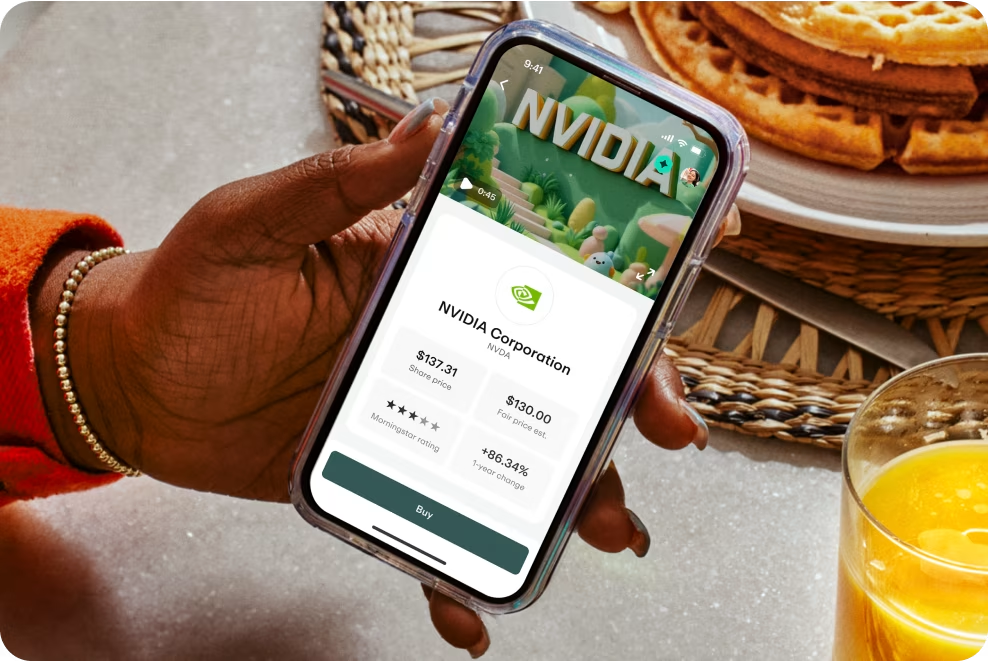
Greenlight's investing tools make it possible for parents and kids to explore the stock market, analyze opportunities and risks, and build lifelong money skills together.
What parents/guardians should know
Choose an app that has parental oversight built in. Gains may be subject to taxes.
2. UTMA/UGMA
What is it?
A UTMA/UGMA is a custodial account that lets adults hold and manage investments on behalf of a minor.
Why is it good for kids?
The adult controls the account until the child reaches adulthood (18–21, depending on the state), at which point full ownership transfers to the child.
What parents/guardians should know
Contributions are irrevocable and may have tax implications.
3. Index funds
What is it?
Index funds are collections of stocks or bonds that follow a specific group of companies, like the 500 biggest companies in the U.S., for example.
Why is it good for kids?
It’s a simple way to spread your money across many companies without having to decide on individual stocks. Instead of trying to hand-pick winning stocks, index funds let you invest in several all at once.
What parents/guardians should know
This is a good next step after your child has tried purchasing individual stocks.
4. 529 savings and investing accounts
What is it?
529 plans are tax-advantaged accounts designed to save for education expenses. Some plans also allow investing in stocks and funds.
Why is it good for kids?
It makes money lessons real and concrete by teaching kids to save for their education, builds financial responsibility, and shows how investments grow over time.
What parents/guardians should know
Contributions grow tax-free, and withdrawals are tax-free when used for qualifying education costs. Up to $35,000 in unused funds can be rolled into a Roth IRA.
5. Exchange-traded funds (ETFs)
What is it?
These are collections of stocks, bonds, or other assets bundled into a single investment you can buy and sell like a stock. They offer instant diversification at low cost.
Why is it good for kids?
ETFs teach kids that diversification reduces risk and show how markets grow over time.
What parents/guardians should know
ETF gains are subject to capital gains tax when sold. The tax impact depends on the account type.
6. ABLE accounts
What is it?
An ABLE account is a tax-advantaged savings and investment account for individuals with disabilities. Annual contribution limits apply.
Why is it good for kids?
This account is owned by the person with the disability, not a custodian. Anybody can add to the account, and it can be used for a wide range of expenses, including education, housing, and healthcare.
What parents/guardians should know
The disability onset must have occurred before the age of 46. It doesn’t affect government benefits like SSI or Medicaid.
7. Municipal bonds
What are they?
Loans you make to state or local governments to fund public projects. They pay you back with interest that’s typically exempt from federal taxes.
Why are they good for kids?
They offer safe, steady returns. Kids learn about low-risk investing while their money supports real community projects like schools and roads.
What parents/guardians should know
They aren’t taxed federally, but some states do tax them. While they’re low-risk, they offer modest returns.
8. Treasury bills
What are they?
T-bills are short-term U.S. government debt securities that mature in days to one year. You buy them at a discount and receive full face value at maturity.
Why are they good for kids?
The returns are modest but safe, which is ideal for teaching kids about guaranteed, low-risk investing.
What parents/guardians should know
T-bill interest is federally taxable but exempt from state and local taxes.
Why start investing early? The case for kids
Albert Einstein has been quoted as saying “compound interest is the eighth wonder of the world.” Whether he really said it or not, it doesn’t take a genius to see why it’s true.
Imagine what would happen if your child started investing $100 a month at age 10 in a 7% investment. Here’s how much money they would earn over the next 20 years:
At age 18 (8 years of investing): $13,042
At age 25 (15 years of investing): $32,126
At age 30 (20 years of investing): $52,397
Johnson said, “The surest way to build true long-term wealth and achieve financial security is to invest in the stock market. Starting early is the key to successfully building wealth because of the effect of compound interest.”
Should you start with individual stocks?
Amy Rosenow, a financial planner and founder of Bold Vision Financial, used Greenlight with her daughters until they were 18, and she has helped them invest as well.
She said, “While in my financial planning practice I predominantly utilize ETFs for their simplicity and diversification in taxable accounts, with children I think it’s helpful to have them invest in individual equities in small amounts.”
She explains that this helps them make the connection between the concept of a diversified ETF or mutual fund and the fact that those instruments “actually hold individual stocks inside of them, which, in turn, represent economic interests in actual companies.”
Investment apps easiest for children to use with a parent
The best accounts for kids to learn about investing are ones in which they can be actively involved in the decision making and can see, in real time, how their money is working for them. They should be able to see the results.
That’s where investment apps come in. When choosing an investing account for your kids, look for one that has ease of use, transparent fees, parental controls, and educational content.
Here are some apps to consider that make investing fun, engaging, and interactive:
It includes a debit card and investing in one app. Kids can search stocks and learn about companies right in the app to help them find stocks they want to invest in. Parent approval is required on every trade.
Stocks are traded through parents’ custodial account.
Designed for teens 13–17, this is a brokerage account that must be converted to a standard Fidelity brokerage account once the teen turns 18.
Lessons in the real investing world
Rosenow recommends having kids pick and research stocks, then purchase and track them together. If you have more than one child, buy the same stocks for each one.
Picking stocks together
In 2015, she did this exercise with her daughters, ages 7 and 10, asking each to pick a publicly traded company they liked and learn how it makes money. One chose Disney, the other Amazon. They discussed how Disney earned from parks, movies, and streaming, while Amazon had its retail site and AWS. They bought 40 shares of Amazon for $1,300 and 10 shares of Disney for $1,100 for each child.
Checking in 10 years later
A decade later, the results were starkly different. “We actually sold the Disney in September 2025, and the profit over the decade was just over $300 … it’s not a great return over a decade. You likely would have earned more interest by leaving your money in a high-yield savings account,” Rosenow said.
However, they held on to that Amazon stock, which grew to $10,300, representing a gain of over 681%. “Thankfully, we did buy both stocks in both girls’ accounts. Otherwise, imagine how sad they would be if one child had that type of return and the other one basically had none,” said Rosenow.
Want to raise future investment experts?
The next time your child wants to buy the latest gadget or food fad, you’ll know what to do. Even better, why not start today? A small start now can ignite a lifetime of smart financial habits.
Greenlight, the #1 family finance and safety app, offers best-in-class financial literacy and investing tools. Check out a free investor course for parents and kids to learn about the stock market, explore opportunities, and build money habits that last a lifetime.
Try Greenlight and see how engaging and easy it is for kids to learn about investing.
About the Experts
Robert R. Johnson, PhD, CFA, CAIA, is a Professor of Finance, Heider College of Business, Creighton University. He is Co-founder and CEO of Economic Index Associates, a NYC-based firm that creates investable indices and was formerly deputy CEO of CFA Institute in charge of the CFA Program and was President of the American College of Financial Services.
Amy Rosenow, CFA, CFP® is an advice-only financial planner with Bold Vision Financial.
© 2025 Greenlight Investment Advisors, LLC (GIA), an SEC Registered Investment Advisor provides investment advisory services to its clients. Investing involves risk and may include the loss of capital. Investments are not FDIC-insured, are not a deposit, and may lose value.
Share