How to build a family chores and allowance system that sticks
Key Takeaways
- To start a chores and allowance pipeline, assign chores based on the age of your child, select a schedule, and set it up using a chore and allowance app like Greenlight or smart display like Greenlight Family Hub.
- Chores teach responsibility, time management, delayed gratification, and financial literacy.
- When kids grow up doing chores, they enjoy an adulthood with stronger relationships, greater professional success, and more independence.
In her popular TED Talk, “How to Raise an Adult” author Julie Lythcott-Haims declared, “Professional success in life comes from having done chores as a kid.” Kids who take on household responsibilities develop stronger work ethic, better time management, and a greater sense of self-reliance.
When paired with an allowance, chores can teach the relationship between work and money. That connection is the foundation of financial confidence and one of the most important things your child can learn before they become an adult.
Many Greenlight families teach the value of earning through allowance and chores. With Greenlight, the family tech company simplifying money, safety, and organization, you can assign repeating chores and one-time tasks, and customize allowance payout frequency in the app. Ready to build a system that works for your family? Here’s how to get started.
Step 1: Choose which chores and jobs to assign
When assigning chores to your kids, consider their ages, which household tasks you need help with, what your kids are good at, and what skills you want them to learn. You can also ask for their POV. Including them at this stage of the game will give them a sense of ownership, which they love.
Age-by-age chores
Think of age-appropriate chores as a progression. Each new skill builds on the skills already mastered, gradually preparing kids for the independence they’ll need as adults.
Ages 3–5
Ages 3–5 — Assign preschoolers and kindergartners simple, supervised tasks like picking up toys, wiping spills, and feeding pets.
Ages 6–8
At this age, they are ready for more independent tasks such as making their bed, setting the table, and light sweeping.
Ages 9–12
Ages 9–12 — Now is the time to introduce responsibility-level tasks, including laundry, dishes, yard basics, and meal prep help.
Ages 13+
Ages 13+ — Teens can be given adult-adjacent tasks, such as watching siblings, mowing the lawn, cooking full meals, and managing their own schedule.
Quick tips for chore assignment
Try rotating chores. For all ages, you may want to rotate chores periodically to keep things fresh and build a broader skill set.
Any task can be a chore. These tasks can be anything (and we mean anything). Greenlight parents aren’t afraid to get creative with their chores. We’ve seen it all, from “Do taxes” to “Make tacos” to “Practice magic.”
Adjust based on your child. Each child is different, so it’s important to adjust expectations as needed and praise effort over perfection.
Step 2: Set up a chore schedule
When your kids know what they’re on the hook for, they can start practicing skills like prioritization and time management. With Greenlight's chore app for kids, you can create custom lists for your family’s needs. Schedule and automate chores to make sticking to a routine easier for everyone.
5 most popular chores for Greenlight families
Weekly chores
Clean your bedroom
Take care of the pet
Take out the trash
Wash the dishes
Read
One-time chores
Wash the car
Mow the lawn
Clean out the garage
Babysit
Seasonal yardwork
Quick tips for chore scheduling
Set chores that repeat once a week, or several times a week, like laundry, dishes or trash.
Post one-time jobs for occasional tasks like yardwork or seasonal to-dos.
You can use chore charts with stickers for younger kids, but Greenlight’s app removes the need for physical charts as kids get older.
Step 3: Decide how much allowance to pay
One of the most common questions parents ask is: how much allowance is enough? There’s no universal answer, but a good starting point is the $1-per-year-of-age rule.
Example: An 8-year-old would earn $8 a week and a 12-year-old earns $12. It scales naturally as your kids get older and take on more responsibility.
Consistency matters more than the amount
Consistency is a huge factor in making your chores and allowance system a success. A smaller allowance paid reliably every week teaches more than a larger one that comes and goes. Here are the lessons you want your kids to walk away with:
Work leads to a predictable reward. That’s a habit that sticks.
Base pay vs. bonus pay are different things. Separate their regular allowance from one-time jobs like washing the car or cleaning the garage, so kids learn what it means to go above and beyond.
Make a plan for your money before it hits your account. Greenlight lets kids divide earnings, so even a modest weekly allowance becomes a hands-on money lesson.
However you land on an amount, Greenlight makes it easy to set up an allowance and chore schedule, so you can focus less on the logistics and more on the lessons.
Step 4: Set up your chore-to-allowance system
Pick a day and decide how and when you’d like their payout to hit. Then, set it on autopilot, sit back and watch them earn and learn. Less work for you is just the icing on the cake. Greenlight’s allowance app features give you three flexible options to teach kids how hard work pays off:
Flat rate: Pay a consistent allowance that isn’t connected to chores and pause anytime.
Partial payment: Pay a percentage of their allowance based on chore completion.
All or nothing: Only pay their allowance if they complete all their chores.
Quick tips for allowance scheduling
Discuss with your child about which model you’re choosing and why. It turns a logistical decision into a money lesson.
Take the learning to the next level with allowance allocation. Kids can divvy up their earnings between spending, saving, parent-approved investing, and giving.
Step 5: Download the app for your kids
Now, it’s their time to shine. Make sure your kids have full visibility of their chore schedule, however that works best for your family. No nagging required!
On the app: Kids can download the Greenlight app on their own devices to check off chores, track their earnings, and receive chore reminders.
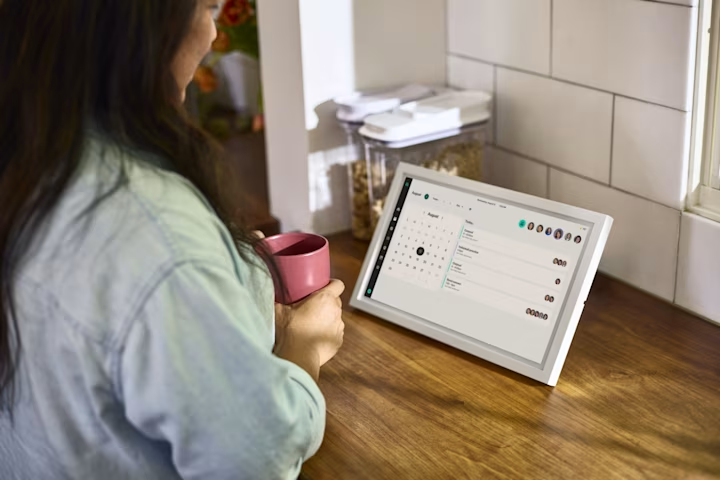
On Family Hub: For a shared, always-on view the whole family can see, Family Hub displays the same chore list on one home base — including for younger kids and family members who don't have their own device. Chores and rewards are included on the free Family Hub plan.
Step 6: Stick to it
Chores and allowance look different for every family. Some families may even choose to offer alternative rewards for chores. However, we all have the same goal: to build the foundation of a healthy and happy future for our kids.
Handling common challenges
Every plan hits a bump in the road now and then. Here’s how to handle the most common ones without derailing the whole system.
“My kid refuses to do chores” Resist the urge to just do it yourself. Instead, use age-appropriate and natural consequences. If chores aren’t done, allowance isn’t paid. Let the system do the talking for you.
“Should I pay for good grades?” It’s best to keep academic incentives separate from chores and allowance. Grades reflect effort in school and chores reflect effort at home.
“My kids fight over who does what!” Rotating assignments every few weeks can eliminate the ownership battles, and kids end up learning a wider range of skills along the way.
“When do I raise the allowance?” Tie allowance increases to age, a new set of responsibilities, or a family “raise” conversation. It’s a good time to talk about what earning more requires in the real world, too.
Why chores matter
Chores are one of the earliest and most effective ways to build the life skills kids need to thrive as adults. Chores teach kids that they are capable and that their contributions matter.
In a 75-year-long Harvard study, researchers identified love and work ethic as the top two things people need to live happy, fulfilling lives. As parents, the love part comes naturally. Work ethic can be taught, and chores are one of the best ways to teach it.
Author Julie Lythcott-Haims takes it a step further. Her research found that kids who do chores grow up to have stronger relationships, greater professional success, and more self-sufficiency than those who don’t. Beyond the research, the day-to-day skills chores build are just as valuable, including:
Responsibility: Following through on a commitment, even when they don’t feel like it.
Time management: Learning to fit tasks into a routine.
Delayed gratification: Understanding that effort now leads to reward later.
Financial confidence: Especially when chores are connected to an allowance.
Teaching work ethic may start with a chore chart, but it ends with a child who knows how to earn, save, spend, and give. Turn chores into money lessons: assign tasks, set rewards, and teach responsibility with the app or Family Hub. Your family. In sync. Try Greenlight.
FAQs
How much allowance should I give my child?
A popular rule of thumb is $1 per week for every year of your child’s age, so a 10-year-old would earn $10 a week.
At what age should kids start doing chores?
Most kids are ready for simple, supervised tasks as early as age 3 or 4, and tasks can get more complex as they grow.
Should I pay kids for chores they should be doing as part of the family anyway?
There are pros and cons to each, but a middle ground that works well for many families is to designate some chores as unpaid and just part of being a family and other chores as extra tasks that earn allowance.
What if my child refuses to do their chores?
Let the system do the work for you. No chores means no allowance. Natural consequences put the choice squarely in your child’s hands.
Can chores and allowance help with a child who has no interest in money or saving?
Yes, especially if you tie their allowance to something they care about, like saving up for a game or an experience.
Share via
Hey, smart parents 👋
Teach money lessons at home with Greenlight’s Smart Parent newsletter. Money tips, insights, and fun family trivia — delivered every month.